The pace of technological change has entered a new era. Previous revolutions, like the telephone or the internet, unfolded over decades. Today, intelligent achieve mass adoption in mere months.
One leading tool gained about 100 million users in two months. For context, the telephone took 50 years to reach 50 million. This acceleration defines our moment.
The velocity extends beyond users. Startups in this field scale revenue five times faster than traditional software companies once did. The knowledge half-life has shrunk to months.
One chief Trends information officer noted that the time to study a new technology now exceeds its window of relevance. This creates a fundamental transformation in how organizations operate.
The central question is shifting content. It is no longer “What can we do?” but “How do we move from experiment to real impact?” This year marks that pivotal turn.
Multiple powerful currents are converging. Their combined effect is multiplicative, reshaping business, technology, and society at an unprecedented scale. The future is being written now.
Key Takeaways
- Adoption rates for modern intelligent tools dwarf those of historical technologies like the telephone or internet.
- Companies building theseare achieving scale at a pace previously unimaginable in the tech sector.
- The useful life of technical knowledge is now extremely short, creating constant pressure to adapt.
- The focus for organizations is moving from initial experimentation to achieving measurable, production-level results.
- We are witnessing a convergence of advancements, where combined trends create effects greater than the sum of their parts.
- This period represents a fundamental shift in how societies and industries will function.
- The changes underway are accelerating in a self-reinforcing cycle of, application, and improvement.
Introduction and Scope
The conversation among technology leaders has moved decisively from theoretical potential to practical execution. They now ask, “How do we move from experimentation to impact?” This urgency year stemgs from an accelerated pace of change.
Context of Rapid AI Advancement
Innovation today compounds through multiplicative forces. Improvements in core technology, data availability, and infrastructure investment all accelerate each other simultaneously
“The time required to study a new technology now frequently exceeds its window of relevance.”
This creates unprecedented challenges. Organizations struggle to maintain advantage when knowledge becomes obsolete so quickly.
| Aspect | Traditional Cycle | Current Cycle |
|---|---|---|
| Adoption Speed | Decades | Months |
| Knowledge Half-Life | Years | Months |
| Investment Focus | Long-term R&D | Rapid scaling |
| Competitive Window | Sustained | Extremely short |
User Intent and Article Overview
This article serves business leaders and technology professionals. It provides actionable information, not speculative futures.
Generative AI Trends 2026
We map five interconnected forces shaping 2026: intelligent systems going physical, agentic reality, infrastructure reckoning, organizational rebuilding, and the security dilemma. This analysis draws on extensive research, including Deloitte’s long-term trend sensing and expert insights.
The coming period marks a clear transition point for strategic planning.
Overview of Generative AI Trends 2026
A recent survey of 500 U.S. technology executives reveals a clear roadmap for the coming year. It is defined by five powerful, interconnected forces.
These currents do not operate in isolation. Their convergence creates a paradigm shift from experimental technology to foundational infrastructure.
| Primary Force | Core Focus for Organizations |
|---|---|
| Intelligent Systems Go Physical | Converging advanced software with robotics for real-world action. |
| The Agentic Reality Check | Preparing for autonomous, silicon-based colleagues in the workforce. |
| Infrastructure Reckoning | Optimizing compute strategy and data pipelines for scale. |
| The Great Rebuild | Architecting tech organizations natively around intelligent capabilities. |
| The Security Dilemma | Leveraging these tools for cyber defense while securing them. |
For business leaders, this means a crucial strategic pivot. The focus must shift from “What can we do?” to “What specific problem should we solve?”
“Success now hinges on connecting every investment directly to a measurable business outcome.”
The year 2026 marks this convergence point. Trends 2026 It demands courage to content redesign, not just automate, across every layer of an organization.
Accelerated AI Adoption and Industry Impact
Adoption curves that once spanned generations now compress into a single fiscal quarter. This unprecedented speed defines the current landscape for all organizations.
The window for gaining a competitive edge is shrinking rapidly. Leaders must understand this velocity to make strategic decisions.
Historical Comparison and Adoption Rates
Historical data reveals the staggering acceleration. What took decades now happens in months.
| Technology | Time to 50M Users | Scale Context |
|---|---|---|
| Telephone | 50 Years | Linear Growth |
| Internet | 7 Years | Exponential Growth |
| Leading Intelligent Tool | 2 Months | Hyper-Growth |
This compression forces a fundamental rethink of business planning cycles. Startups in this field scale revenue five times faster than traditional software firms once did.
Case Studies from Leading Technology Firms
Successful companies share a common pattern. They lead with specific business problems, not just technology.
| Company | Key Insight from Leadership | Strategic Approach |
|---|---|---|
| Broadcom | “Without focusing on a specific business problem… you could invest and receive no return.” | Value-driven investment |
| UiPath | “Attack your biggest problem and go for a big outcome.” | Prioritize major challenges |
| Western Digital | “We’d rather fail fast on small pilots than miss the wave entirely.” | Favor velocity over perfection |
| Walmart | Involved store associates in app development | Human-centered design |
| Coca-Cola | Moved from “What can we do?” to “What should we do?” | Strategic problem selection |
Research shows these patterns are critical. Organizations achieve real impact by defining clear outcomes and enabling rapid experimentation.
The acceleration creates both immense opportunity and risk. The strategy must be continuous adaptation.
Organizational Transformation in the Age of AI
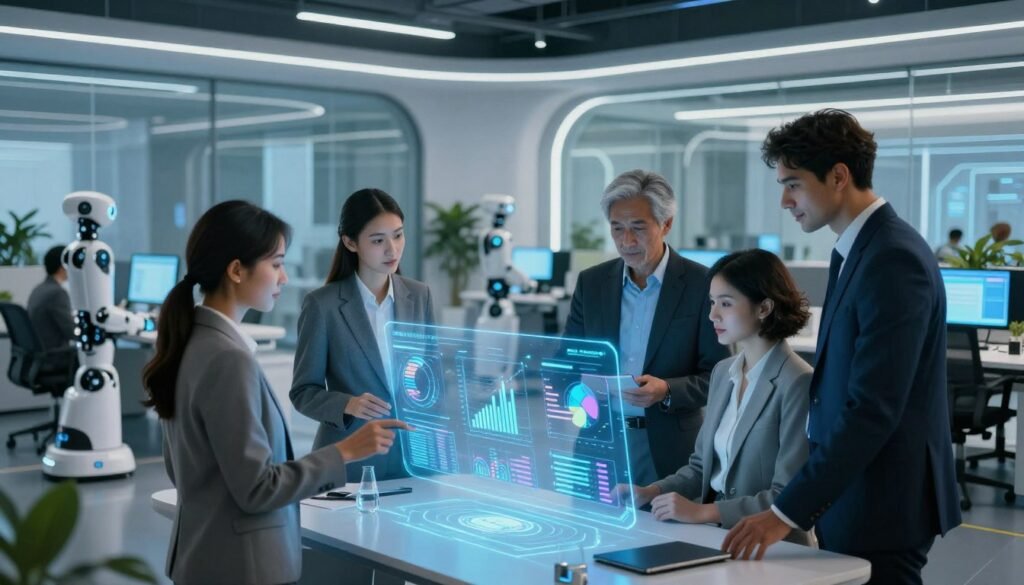
Companies are no longer just adopting new tools; they are rebuilding their entire operating models from the ground up. A Deloitte survey reveals that 99% of IT leaders report major changes are underway. This represents a wholesale shift in how technology organizations structure and operate.
Redesigning IT Operating Models
Success requires a bold reimagination of traditional service delivery. Leaders must transition to AI-native architectures that support continuous.
These new models feature modular designs and embedded governance. They are built for perpetual evolution, not just periodic updates. As HPE’s CFO stated, the goal is to select processes for complete transformation.
“We wanted to select an end-to-end process where we could truly transform, not just solve for a single pain point.”
Human-Agent Team Integration
The next challenge is designing effective workflows for hybrid teams. This involves new approaches to task allocation and quality control between people and intelligent agents.
Harvard Business School’s Tsedal Neeley introduces a crucial concept: change fitness. It is the capacity to metabolize ongoing change. She emphasizes that every employee needs at minimum a 30% digital and intelligent mindset.
This fluency allows work to be redesigned. Organizations succeed when they foster this capability across all levels.
The Rise of Agentic AI and Autonomous Agents
A significant shift is underway as autonomous software entities move from conceptual pilots to core operational components. Despite widespread experimentation, a stark gap exists. Only 11% of organizations have these agents in full production
Most are still piloting or lack a clear plan. This highlights content a critical transition challenge.
Transition from Experimentation to Production
Moving beyond tests requires more than technology. Gartner predicts 40% of agentic projects will fail by 2027. Failure often stems from automating broken processes instead of redesigning them.
IBM’s Chris Hay notes the rise of the “super agent.” These systems coordinate workflows and execute multi-step tasks autonomously. They operate across tools without constant human input.
Writer’s Kevin Chung identifies key trends. Intelligence is shifting from individual use to team orchestration. Agents are becoming proactive collaborators.
Generative AI Trends 2026
Democratization allows business users to build agents, accelerating . Standardization efforts like MCP, ACP, and A2A enable interoperability. The Linux Foundation’s Agentic AI Foundation supports this agents.
Success demands a structured strategy with clear governance. It requires building for human oversight at critical points. The goal is effective, safe autonomous operations.
AI Infrastructure and Compute Evolution
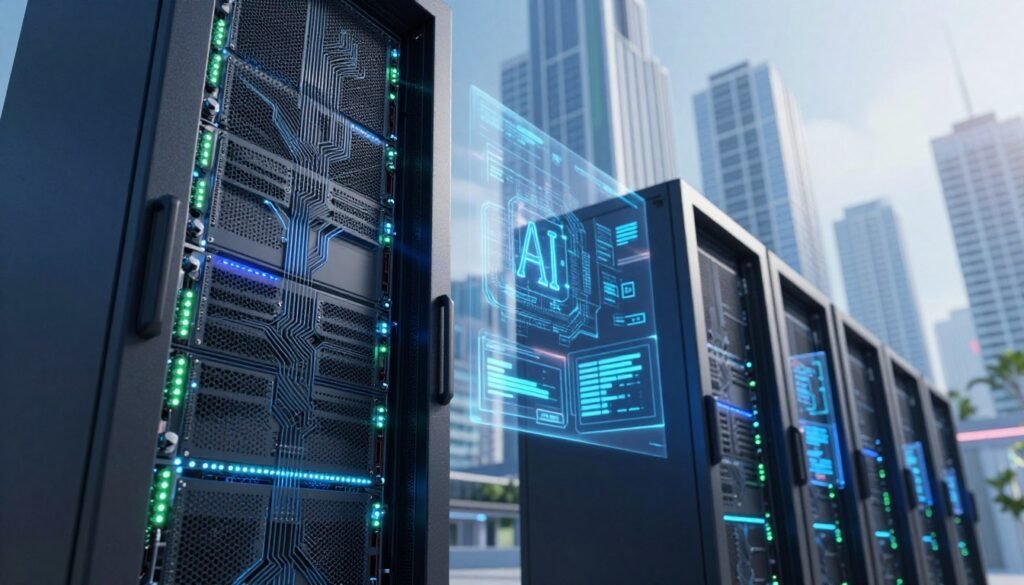
Enterprise leaders are confronting a harsh economic reality in their compute strategies. Token costs fell 280-fold in two years. Yet, monthly bills for some firms still reach tens of millions.
Usage exploded faster than prices agentsdropped. This paradox forces an infrastructure reckoning. Existing systems built for cloud-first approaches cannot scale.
Hybrid Cloud and On-Premises Strategies
A strategic shift is underway. Organizations are moving from a cloud-only mindset to a hybrid strategy. They now match workloads to the best environment.
| Deployment Model | Key Characteristic | Primary Use Case |
|---|---|---|
| Public Cloud | Elasticity | Spiking, variable workloads |
| On-Premises | Consistency & Control | Core, sensitive data pipelines |
| Edge | Immediacy | Low-latency inference |
The compute landscape is diversifying. GPUs remain critical, but new accelerators are emerging. Experts point to ASIC-based designs and chiplets.
Efficiency is now a major scaling factor. Techniques like distillation and quantization help. They enable models to run on smaller, edge .
This addresses cost, latency, and data sovereignty needs. Successful infrastructure planning treats compute as a portfolio. It requires continuous agents optimization, not a one-time choice.
Enhancing Security and Cyber Defense with AI
Organizations must now secure a new frontier where non-human digital actors outnumber their human counterparts. This creates a dual challenge. The same technology that introduces novel vulnerabilities also provides the most advanced defense tools.
The primary difference is velocity. As AT&T’s CISO noted, the threats are familiar, but their speed and impact are unprecedented.
“What we’re experiencing today is no different than what we’ve experienced in the past. The only difference with AI is speed and impact.”
Securing Data, Models, and Infrastructure
Protection must span four critical domains. These are the used for training, the models themselves, the applications, and the underlying infrastructure.
Data sovereignty and strict permissioning become non-negotiable. Leaks or agentsprompt injection attacks can erode trust in entire .
Feeding models permission-aware, structured is essential. This builds a foundation for secure, auditable operations.
AI-Powered Defense Mechanisms
To combat machine-speed threats, organizations are turning to defensive intelligence. These mechanisms detect anomalies and adapt in real-time.
A major new concern is non-human identity management. Agentic software will soon dominate digital access points.
“In the coming years, agentic AI and other non-human identities will outnumber human users in the organization significantly. This is now a board-level concern…”
This demands new governance. Leaders must answer three questions. Do we know every agent that exists? Do we understand what it is accessing? Are we confident in its actions?
Perimeter defense is inadequate. A fundamental rethink of security frameworks is required for organizations to thrive.
Generative AI and Robotics: Bridging the Virtual-Physical Divide
The next major frontier for intelligent is not in software alone, but in their ability to directly manipulate and navigate the physical world.
Intelligence is becoming agents embodied, autonomous, and focused on solving tangible problems. This moves advanced from answering questions to directly influencing outcomes.
Deployment in Physical Environments
Practical applications are already delivering measurable value. Amazon’s DeepFleet AI coordinates its vast robot fleet, improving warehouse travel by 10%.
In BMW factories, cars drive themselves through kilometer-long production routes. These are not proofs of concept but dependable operational .
| Sector | Key Physical Tasks | Role of Intelligent Systems |
|---|---|---|
| Manufacturing | Assembly, quality inspection, material handling | Autonomous navigation, precision execution |
| Logistics | Sorting, picking, packing, transportation | Fleet coordination, route optimization |
| Healthcare | Surgical assistance, patient mobility, lab work | Enhanced dexterity, sterile procedure support |
| Field Service | Infrastructure inspection, maintenance, repairs | Environmental sensing, adaptive task execution |
As IBM’s Peter Staar notes, “Robotics and physical AI are definitely going to pick up. People are getting tired of scaling and are looking for new ideas.” This signals a search for the next wave of innovation.
The work for people is evolving. They transition from performing manual tasks to supervising and collaborating with these system. The goal is a dependable partner for complex enterprise workflows.
Emerging Hardware and Edge Innovations for AI
The future of computing infrastructure hinges on a diversified portfolio of specialized processors. Moving beyond general-purpose chips, new designs target specific workloads for greater performance and efficiency.
This shift unlocks new at the edge and in the data center. It represents a fundamental change in how organizations approach their technology stack.
ASIC, Chiplet Designs, and Quantum-Assisted Computing
IBM has stated that 2026 marks a pivotal milestone. Quantum computers will achieve a practical advantage over classical for specific problems.
This breakthrough could revolutionize drug development and materials science. It solves optimization challenges that are currently intractable.
“Today, we’re using the industry’s best-available quantum computers for real use cases. While these aren’t production-scale problems, they’re signals where we expect value to increase as quantum continues maturing.”
Hybrid architectures are emerging. Companies like AMD and IBM are integrating CPUs, GPUs, and FPGAs with quantum processors.
This creates quantum-centric supercomputing. It efficiently accelerates a new class of complex algorithms.
Specialized hardware for agentic workloads is also predicted. These chips would differ from traditional training or inference silicon.
| Compute Paradigm | Key Innovation | Primary Advantage |
|---|---|---|
| Quantum-Centric Supercomputing | Hybrid quantum-classical architecture | Solves intractable optimization problems |
| Specialized ASICs | Application-specific silicon | Unmatched for target tasks |
| Edge-Optimized Models | Distilled, quantized models | Runs on modest devices with low latency |
Efficiency is now the critical scaling frontier. Techniques like model distillation push intelligence to edge clusters and embedded devices.
Smaller, domain-optimized models deliver impressive results. They meet strict cost, latency, and -sovereignty requirements.
Leaders must treat hardware strategy as a portfolio. They balance frontier innovation for breakthroughs with efficient deployment for widespread adoption.
Business Strategy and Workforce Transformation
Strategic leaders face a critical choice: rebuild core from scratch or apply incremental upgrades to existing workflows. This decision defines their strategy and long-term impact.
Harvard’s Tsedal Neeley states the imperative. “The leadership imperative for 2026 is clear: make change fitness a core capability, not an afterthought. Invest in broad AI literacy, redesign workflows (not just jobs), and reward learning speed and outcomes.”
Strategic Rebuilds versus Incremental Upgrades
Successful businesses choose complete transformation. They avoid automating broken ways of working. This demands courage from leaders.
Jacqueline Ng Lane’s research offers guidance. Sequence predictive tools first for sustaining . Use generative capabilities first for R&D or new markets. Organize AI around strategy.
Jon Jachimowicz warns of a hidden cost. “If AI makes the work 20% more productive, but 20% less meaningful, what is actually the net benefit?” People need connection to the beneficiaries of their work.
Elevating Human-AI Collaboration
The goal is designing workflows where people and artificial intelligence complement each other. This elevates human roles toward judgment and insight.
David Fubini notes the shift in professional “Advantage will flow to those closest to their clients. Differentiation will shift from technical firepower to human judgment, insight, and the ability to build meaningful relationships.”
Building this future requires new governance. It balances with quality and human experience. Teams must develop fluency with these tools.
Leaders must measure outcomes beyond productivity. They should track, engagement, and strategic advantage. This way of thinking turns challenges into lasting value.
Conclusion
As we look ahead, the true differentiator for businesses will be their capacity for continuous adaptation and redesign. Kelly Raskovich of Deloitte notes that successful demonstrate courage to redesign, discipline to link investment to outcomes, and speed to act before the window closes.
This year marks a convergence where multiple artificial intelligence capabilities mature. The gap between leaders and laggards grows exponentially. Navigating this future requires addressing interconnected challenges across infrastructure, security, and workflows.
The critical barrier is moving from experiment to production. It demands fundamental redesign, not automating broken processes. Competitive advantage shifts to the strategic orchestration of and tools.
Leaders must balance with meaning, and automation with human judgment. Security and governance are non-negotiable foundations. The role of leadership is to build capable of constant evolution.
The defining challenge is translating knowledge into action. The impact on the world depends on this work. The time for decisive way forward is now.