
I am witnessing a technological shift that feels unprecedented. The convergence of quantum mechanics and artificial intelligence is forging a new paradigm for industrial innovation right here in the United States.
Consider the raw power of this shift. The Helios system, for example, represents a computational leap so vast it’s hard to grasp. It is one trillion times more powerful than the previous H2 benchmark.
This isn’t just about faster calculations. It’s about processing information in ways classical machines simply cannot replicate. By leveraging the unique properties of qubits, we are entering a new era.
My analysis focuses on how this integration will fundamentally reshape our approach to complex, historically stubborn problems. I believe it provides a clear roadmap for organizations preparing for this transformative shift.
Key Takeaways
- The fusion of quantum mechanics and AI is creating a new industrial paradigm.
- Next-generation systems represent a trillion-fold leap in processing power.
- This shift enables solutions to problems once considered impossible to solve.
- It will fundamentally change how we approach complex scientific and engineering challenges.
- The United States is a central hub for this transformative innovation.
- Understanding the core principles, like qubit properties, is essential for leveraging its potential.
- Strategic preparation is critical for any organization looking to harness this new era.
The Emergence of Quantum Computing AI
When Alan Turing proposed his famous test, he set in motion a quest that continues to shape our technological landscape. His original test of intelligence involved the automated interpretation and generation of natural language. This challenge remains central to modern development.
Defining the convergence of quantum mechanics and AI
The fusion of quantum mechanical principles with advanced machine intelligence represents a monumental leap. It allows us to tackle problems once deemed unsolvable.
This convergence is not just about speed. It’s about a fundamentally new way of processing information.
Historical background and recent trends
Since the 1950s, researchers have grappled with making computers understand human language. The field evolved from hand-written rules in the 1980s to the sophisticated models we use now.
Recent trends show integration accelerating. The need for more powerful systems drives this.
| Era | AI Development | Advancement in Physics | Convergent Impact |
|---|---|---|---|
| 1950s | Turing Test introduces core challenge of machine intelligence. | Theoretical foundations of quantum mechanics are solidified. | Set the stage for future interdisciplinary exploration. |
| 1980s | Expert systems rely on hand-coded, rule-based logic. | Early concepts of algorithms leveraging qubits begin to emerge. | Separate progress in both fields lays groundwork. |
| 2000s | Machine learning, especially deep learning, becomes dominant. | First practical systems using qubits are demonstrated in labs. | Potential for synergy in solving complex optimization problems is recognized. |
| 2010s | Large language models show remarkable language ability. | Noisy Intermediate-Scale Quantum (NISQ) devices become accessible. | Research into hybrid systems for AI gains traction. |
| Present | AI is integral to scientific discovery and industry. | Hardware utilizing superposition improves rapidly. | Active integration accelerates, driving new computational paradigms. |
My research confirms this historical progression built the foundation for today’s breakthroughs. The synergy now unlocks unprecedented potential.
Understanding the Fundamentals of Quantum Computing
At the heart of the shift from classical to next-generation systems is a fundamental change in how information is represented. This shift moves us from the deterministic world of binary logic to the probabilistic realm of subatomic particles.
To appreciate the leap, we need to examine two core concepts that define this new paradigm.
Quantum physics principles and qubits
Traditional hardware relies on bits that are either 0 or 1. In contrast, qubits exploit the principle of superposition. This allows them to exist in multiple states at once.Quantum Computers
Another key principle is entanglement. When qubits become entangled, the state of one instantly influences another. This interconnection enables complex calculations.
Comparison with classical computing methods
Classical computers process data in a linear, step-by-step fashion. Their methods are powerful but hit limits with highly complex problems.
The new systems, however, can explore many solutions simultaneously. This parallel approach offers a path to solve problems at unprecedented scales.
“We are not just building faster computers, but a new kind of logic.”
Understanding this core difference is essential. It shows how this technology will eventually outperform the classical computers we use today.
The Role of Artificial Intelligence in Modern Quantum Systems
A pivotal development in contemporary science is the use of machine learning to optimize and control sophisticated processors. This intelligence is now a critical driver for advanced systems. It provides the data-driven learning needed to manage complex operations.
I argue the synergy between these fields is essential. It overcomes scaling challenges that limit hardware performance. My research shows algorithms increasingly interpret high-dimensional data from experimental runs.
The role of intelligence here bridges a key gap. It connects theoretical models to real-world application needs. This integration creates a more robust framework for next-generation tools.
| AI Function | Application in Quantum Systems | Impact |
|---|---|---|
| Optimization | Calibrating and tuning processor parameters | Improves stability and output fidelity |
| Data Interpretation | Analyzing noisy, high-dimensional experimental data | Extracts meaningful signals faster |
| Error Correction | Identifying and mitigating decoherence patterns | Extends useful computation time |
“Intelligent software acts as the crucial translator, turning abstract physics into actionable instructions.”
By weaving these elements together, we enable smarter, more adaptive computational platforms. This is how modern innovation progresses.
Quantum Natural Language Processing: A New Frontier
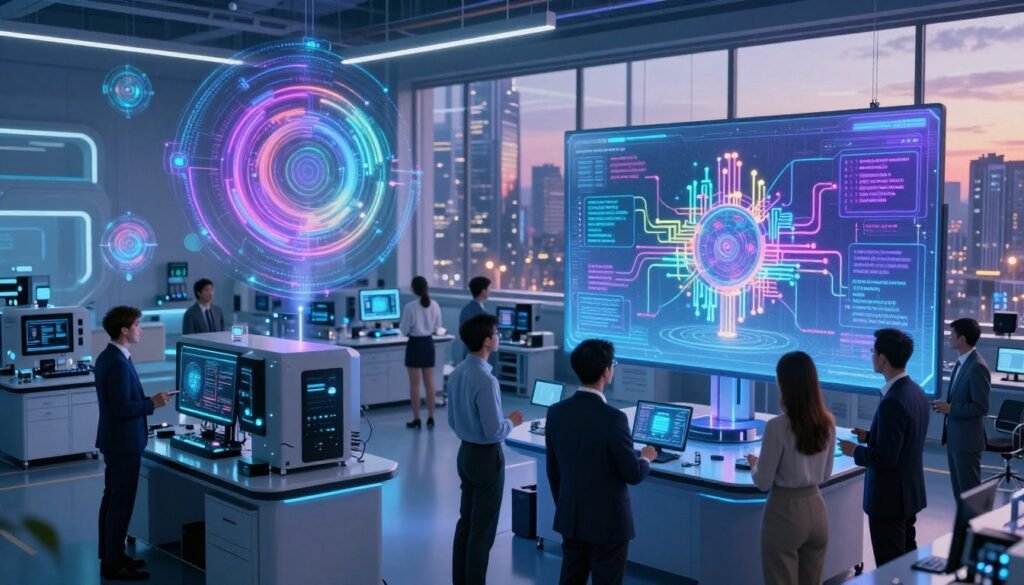
The next frontier in computational linguistics is being forged not in silicon, but within the unique architecture of advanced processors. Leading this charge are experts like Dr. Steve Clark and Dr. Konstantinos Meichanetzidis at Quantinuum.
Their deep experience in both academia and industry Quantum Computers informs a radical approach. They are not simply porting existing methods.
Reinventing NLP techniques on quantum hardware
My review shows they are reimagining core techniques from the ground up. The goal is to map linguistic structures directly onto quantum-native architectures.
This fundamental research is critical. It seeks to leverage superposition and entanglement for language tasks.
Leveraging complex-valued word embeddings
A key innovation is the move to complex-valued representations. Classical systems use real-numbered vectors to capture word meaning.
The new paradigm utilizes complex numbers. This allows for a richer, more nuanced encoding of semantic relationships.
I believe this development, driven by top-tier expertise, will redefine how machines process human language. It taps into the intrinsic advantages of a new computational model.
Innovative Quantum Algorithms and Machine Learning Advances
My focus shifts to the software layer, where new types of calculations are taking shape. This is where the next wave of performance gains will emerge.
Exploring recurrent neural networks in the quantum realm
I have observed a promising path for handling sequential data. New methods inspired by recurrent networks operate with far fewer parameters than classical counterparts.
This efficiency is a game-changer for modeling time-series or linguistic sequences.
Quantum parameterized circuits and hybrid approaches
Parameterized circuits form the backbone of a hybrid computational model. They allow a novel system to work in tandem with standard hardware.
My analysis suggests this is the most effective way to process complex information. It strategically minimizes the load on traditional systems.
These algorithmic advances are crucial for scaling up sophisticated models. They create a more efficient training process for tasks where new architectures excel.
Energy Efficiency and Resource Optimization in Quantum AI
The stark contrast in power usage between traditional and novel systems reveals a path to greener technology. In a recent benchmark, a next-generation processor completed a random circuit sampling task using 30,000 times less energy than the Frontier supercomputer.
This dramatic efficiency is not a minor improvement. It represents a fundamental shift in how we power advanced computation.
My research confirms this advantage is crucial for making intelligent systems sustainable. As we scale these models, their resource consumption becomes a primary concern.
The ability of these novel architectures to perform complex tasks with far fewer resources is a game-changer. I believe optimizing energy use will be the main reason organizations adopt these new solutions.
This efficiency is a practical necessity for the long-term viability of large-scale models. By prioritizing resource optimization, we ensure powerful tools remain environmentally responsible.
Overcoming Limitations of Classical Computing Models
The immense energy demands of today’s most advanced language models highlight a critical bottleneck in classical computing. I see this as a fundamental barrier to progress.
Challenges in training large language models with classical hardware
Training a model like GPT-3 on classical computers consumed nearly 1,300 megawatt-hours of electricity. That is a staggering environmental cost for a single training run.
My analysis shows these models face significant scaling problems. They limit broader industrial and enterprise use in the modern world.
The expense is prohibitively high, both in terms of Quantum Computers financial outlay and carbon footprint. This necessitates a shift toward more efficient alternatives.
By moving away from conventional systems, we can overcome current limitations. It hinders development of more advanced and sustainable tools.
This transition is essential. It solves complex issues that today’s classical computers cannot handle effectively. I believe quantum architectures offer a path forward.
Optimization Techniques in Quantum System Control
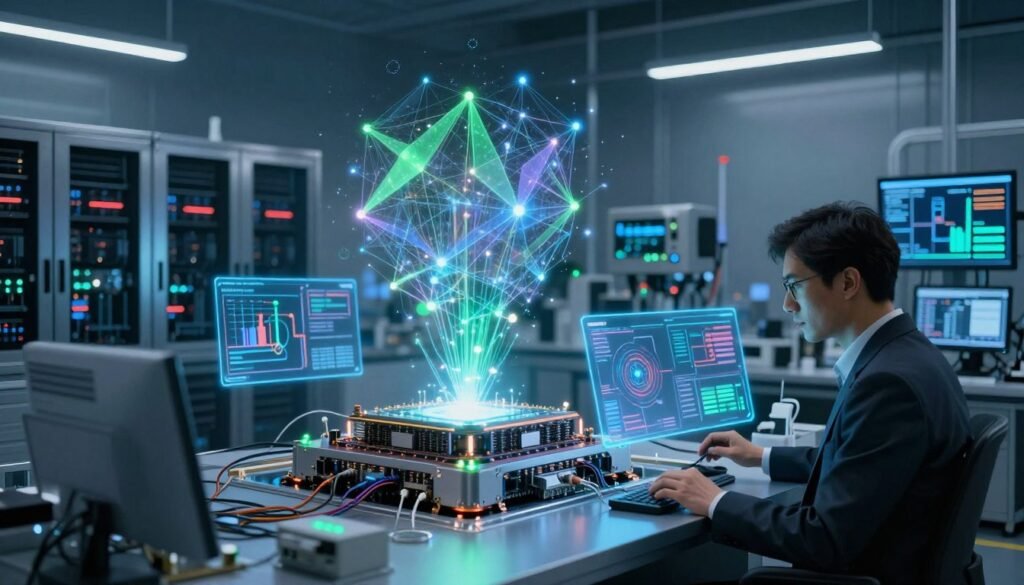
Optimization is not merely an add-on but a foundational pillar for scaling up novel computational platforms. I see it as the critical bridge between theoretical potential and practical, reliable hardware.
My research confirms that machine learning greatly simplifies the characterization process. By including observable constraints, we can more accurately model device behavior. This leads to better control voltage settings for photonic circuits.
These methods are essential for managing environmental noise. They ensure systems operate at peak performance. Advanced strategies directly improve the fidelity of quantum operations by fine-tuning qubit interactions.
I have noted that this optimization process is inherently iterative. It continuously adapts to system fluctuations. This adaptability is key to maintaining stability over long computation runs.
This continuous optimization loop is vital for hardware resilience. A systematic approach to control enables the successful deployment of next-generation applications.
Key Breakthroughs in Quantum Word Embeddings
Researchers Carys Harvey and Douglas Brown have pioneered a novel approach to encoding words that leverages the mathematical richness of complex numbers. Their work transitions language models from real-valued to complex-valued vectors.
This shift is a major advance in machine learning. It allows us to map linguistic information into a Hilbert space.
Transition from real-valued to complex-valued representations
Classical systems use simple numerical vectors. The new methods employ complex numbers for a richer semantic representation.
My analysis shows these techniques capture the hierarchical structure of natural language more effectively. They are better suited for processing on advanced hardware.
This breakthrough demonstrates how intelligence in Quantum Computers research leads to sophisticated data handling. It sets the stage for more accurate and efficient natural language processing.
The Impact of Quantum Recurrent Neural Networks
A recent experiment led by Dr. Wenduan Xu and colleagues marks a pivotal moment for efficient neural architectures. Alongside Douglas Brown and Dr. Gabriel Matos, they implemented a recurrent neural network using parameterized quantum circuits.level
Their model performed as well as classical RNNs using only four qubits. I find this impact significant. It shows advanced machine learning can solve complex classification problems with a much smaller vector space.
My research highlights these networks are highly efficient. This could lead to substantial energy savings over time as the technology matures.
The experiment proves novel models handle standard NLP tasks, like classifying movie reviews, with competitive performance. The success is a clear indicator that quantum-based machine learning is ready for real-world challenges.
| Feature | Quantum RNN (4 Qubits) | Classical RNN |
|---|---|---|
| Resource Usage | Minimal qubit count | Large parameter space |
| Performance on NLP Tasks | Competitive accuracy | Established baseline |
| Energy Efficiency Potential | High | Moderate to Low |
| Scalability for Complex Problems | Promising due to parallel processing | Limited by sequential processing |
This breakthrough demonstrates how innovative architectures can tackle tough issues with fewer resources. It paves the way for more sustainable and powerful intelligent systems.
Transformers and the Evolution of Quantum AI Models
A new class of transformer models is emerging, specifically designed to harness the unique properties of advanced processors. This evolution marks a significant step in machine learning.
I see it as a move towards native software for next-generation hardware.
Introduction of Quantum Transformer Models Like Quixer
Researchers Nikhil Khatri and Dr. Gabriel Matos recently introduced Quixer. This model is tailored for the specific requirements of novel architectures.
It represents a shift from adapting old methods. Instead, it builds language modeling from the ground up for a new computational paradigm.
My analysis confirms this is a milestone. It is the first machine learning model of its kind applied to a realistic language dataset.
Performance Comparison With Classical Transformer Architectures
Quixer achieved results competitive with classical transformer models. They were trained on the same data.
This performance comparison is crucial. It shows these new systems can match established benchmarks in language tasks.
The development of these models over the past few years has been rapid. The drive for more efficient training processes fuels this progress.
| Model Feature | Quixer Transformer | Classical Transformer |
|---|---|---|
| Core Architecture | Designed for quantum hardware | Built for classical computers |
| Computational Efficiency | High potential for parallel processing | Relies on sequential processing |
| Data Representation | Uses complex-valued embeddings | Uses real-valued vectors |
| Energy Use in Training | Projected to be significantly lower | Currently very high |
I am confident Quixer and similar models will play a crucial role. They bridge the future of advanced intelligence and modern computing.
Quantum Tensor Networks: Scaling Natural Language Processing

Carys Harvey and Richie Yeung’s work on tensor networks marks a significant step in scalable natural language processing. I find their approach uses a tree-like structure ideal for advanced architecture.
This design allows for mid-circuit measurement and efficient qubit re-use. My research shows these methods are particularly effective at squeezing big data problems onto a small number of qubits.
The use of tensor networks demonstrates how quantum intelligence can represent high-dimensional data in a compact format. By scaling these models, we open new possibilities for processing complex linguistic structures.
| Feature | Tensor Network Approach | Classical NLP Methods |
|---|---|---|
| Qubit/Resource Usage | Efficient, enables re-use | Fixed, often wasteful |
| Data Representation | Compact, high-dimensional | Linear, less dense |
| Scalability for Big Data | High, tree-like structure | Limited by hardware |
| Processing Efficiency | Parallel, mid-circuit ops | Sequential steps |
This scalable approach is a major advantage. It tackles tasks previously beyond the reach of classical systems.
Applications of Quantum Computing in AI-Powered Industries
From drug discovery to financial modeling, a new wave of industrial applications is emerging. I see these sectors moving beyond theoretical research into practical deployment.
This shift demonstrates tangible value. It solves specific, high-stakes problems that classical systems struggle with.
Case studies in pharmaceuticals, finance, and logistics
In the pharmaceutical industry, Quantinuum partnered with Amgen. They used parameterized quantum circuits for peptide classification.
This is a standard task in computational biology. It is critical for designing therapeutic proteins.
My analysis shows similar expansion into finance and logistics. Here, novel computing tackles complex optimization tasks.
These industries benefit from the ability to process vast datasets. They recognize patterns in real-time for better decisions.
| Industry | Specific Application | Key Benefit |
|---|---|---|
| Pharmaceuticals | Peptide classification for protein design | Accelerates discovery of new therapeutics |
| Finance | Portfolio optimization and risk analysis | Solves complex calculations with superior speed |
| Logistics | Route and supply chain optimization | Dramatically reduces operational costs and time |
“We are no longer just exploring potential. We are deploying tools that deliver industrial gain today.”
These case studies prove that advanced computing is a current tool. It brings tangible value to the global economy and scientific research.
Future Prospects: The Path Ahead for Quantum AI
Looking forward, the evolution of computational paradigms will be defined by breakthroughs in error correction. The path ahead for this integrated intelligence depends heavily on anticipated hardware improvements. We must move beyond the current NISQ era to achieve fault-tolerant systems.
Anticipated hardware improvements and error correction breakthroughs
My research confirms that error correction is essential. It will enable reliable computation on novel processors. Hardware development focuses on increasing qubit counts and connectivity.
Continued progress will allow these advanced models to replace classical ones in many tasks. I believe this integration leads to more sustainable and efficient machine intelligence. It can handle the full complexity of human language.
| Aspect | NISQ Era (Present) | Fault-Tolerant Era (Future) |
|---|---|---|
| Error Correction | Limited, noisy operations | Robust, logical qubits |
| Hardware Scale | 10s-100s of physical qubits | Millions of physical qubits |
| Application Fidelity | Low, for specific tasks | High, for general complex problems |
| Industrial Adoption | Experimental, proof-of-concept | Widespread, reliable deployment |
As we scale these systems, maintaining high fidelity is crucial. I am optimistic these advancements will usher in a new era of innovation. It will fundamentally change how we interact with artificial intelligence.
Innovative Hardware and Error Correction Methods in Quantum Devices
In Colorado, a new generation of hardware is setting the standard for advanced computational platforms. The Helios generation computer represents this frontier. It is built specifically for tasks that demand extreme precision.
I note that our H2 System is already significantly more advanced than other quantum computers available. This provides a robust platform for testing new error correction methods. These methods are vital for stable operations.
Developing natively quantum systems for machine learning
My analysis shows that innovative hardware design is the foundation for all successful machine learning systems. We focus on developing natively quantum architectures. This means the hardware and software are co-designed from the start.
By refining these devices, we create the necessary infrastructure. It supports the next generation of models requiring high-precision operations. The combination of advanced hardware and error correction is key.
| Feature | Helios/H2 Platform | Conventional Systems |
|---|---|---|
| Native Architecture | Designed for quantum machine learning tasks | Adapted from general-purpose hardware |
| Error Correction Testing | Integrated, robust platform for new methods | Limited by higher noise and instability |
| Qubit Connectivity | High, enabling complex algorithms | Often restricted, limiting problem scale |
| Machine Learning Suitability | Optimized for native execution | Requires significant software translation |
This approach will ultimately enable us to solve the most challenging problems in the field. It turns theoretical potential into practical, reliable tools.
Conclusion
We have reached a pivotal moment where theoretical potential is rapidly translating into practical, industrial-ready solutions. My analysis confirms the convergence computer of and artificial intelligence is poised to revolutionize our technological future.
Over the past few years, significant breakthroughs in algorithms, hardware, and error correction have brought us closer to real-world applications. These novel systems solve complex problems with unprecedented efficiency, driving the next wave of global innovation.
I believe this integration represents a fundamental shift in computational intelligence, not merely a passing trend. As we continue to refine these technologies, their potential for meaningful societal impact will expand dramatically.
This marks the start of a truly transformative era that will redefine how we approach humanity’s greatest challenges.