The artificial intelligence landscape for 2026 is not a race with one winner. It is a field of specialized systems, each built to excel at specific, practical jobs. The idea of a single, dominant model is gone.
Success now comes from mastering particular functions. The performance gap between top U.S. labs and competitors from China, France, and other regions has nearly closed. Global players are now major competitors, leading in key areas.
Best AI Models 2026
As we track the advancements in AI, it’s clear that the best models, including the Gemini Pro, are shaping the future. The best model will depend on how effectively these systems handle tokens and code in various applications.
The definition of a competitor has shifted. It is no longer just a “model” like GPT-4. Today’s leaders are entire systems with complex, multi-part architectures.
OpenAI’s GPT-5 acts as a unified system. It uses an internal router to pick the right model for each request in real time. Anthropic’s Claude 4.5 is designed as an agentic system. It can work autonomously for hours. Google’s Gemini 2.5 is a “thinking model.” It dynamically allocates computing power to reason through problems before answering.
This means the best choice depends completely on the specific task and performance needs. There is no one-size-fits-all solution. This article provides a detailed, data-driven comparison of three leading systems: ChatGPT (GPT-5), Claude (4.5 Sonnet), and Gemini (2.5 Pro).
Key Takeaways
- The 2026 AI landscape is defined by specialized systems, not a single superior model.
- Global competition is intense, with labs worldwide challenging traditional U.S. dominance.
- Modern AI “competitors” are complex systems with advanced architectures like routing and agentic capabilities.
- Selecting the right tool depends entirely on the specific task and required performance.
- This comparison of ChatGPT, Claude, and Gemini is based on measurable benchmarks, not marketing claims.
- Understanding these foundational systems is a core skill for developers and business leaders.
Introduction to the 2026 AI Landscape
With over a million distinct systems now available, the era of seeking a single, universal solution is decisively over. This proliferation is fueled by massive investment, with worldwide spending on generative tools projected to reach $644 billion in 2025.
This growth has triggered intense specialization. Different systems are engineered to excel in unique domains like creative writing, complex coding, or deep reasoning. The landscape has fragmented into a constellation of specialized tools.
Best AI Models 2026
For professionals, this creates both immense opportunity and significant complexity. Selecting the right tool is no longer a casual choice but a core strategic skill. Success depends on matching a system’s specific capabilities—like reasoning power or multimodal analysis—to the task at hand.
Gone is the notion of one dominant model. The modern challenge is navigating a vast ecosystem to find the precise tool that delivers the required performance. This strategic selection forms the foundation for effective use in any workflow.
Overview of Leading AI Contenders: ChatGPT, Claude, and Gemini
Professionals now choose between three primary architectures, each with a unique design philosophy. These systems are not just language models. They are complex platforms built for specific types of work.
Understanding their core differences is the first step to effective use.
ChatGPT – Unified Intelligence and Adaptability
OpenAI’s GPT-5 functions as a unified system. It uses intelligent routing to match queries with the right internal model. This makes it a versatile tool for everyday tasks.
Simple questions get fast answers. Complex problems are escalated to a deeper “thinking” model. Users rarely encounter rate limits, making it reliable for varied workloads.
Claude – Safety-First and Extended Reasoning
Anthropic’s Claude 4.5 Sonnet is a hybrid reasoning model with safety as a core feature. It supports a massive one-million-token context window.
Its “extended thinking” mode dedicates more computational power to difficult prompts. This design excels at writing and coding, adapting quickly to user style.
Gemini – Multimodal Power and Dynamic Reasoning
Google’s Gemini 2.5 Pro is a powerhouse for multimodal input. It handles text, audio, image, and video seamlessly.
Built on a Mixture-of-Experts architecture, it dynamically allocates compute for tough problems. Gemini Pro also offers the longest context window of any major system, crucial for analyzing large documents.
Performance Benchmarks Across General Intelligence & Multimodal Reasoning
Beyond marketing claims, standardized benchmarks reveal the true strengths of each platform. These evaluations measure core capabilities like general intelligence and multimodal reasoning.
They provide a data-driven way to compare the leading systems.
Human Preference and LMArena Scores
The LMArena, or Chatbot Arena, is the gold standard for human preference testing. Users rank two anonymous model outputs in a blind test.
Its Elo score shows which tool feels best to use. Gemini 2.5 Pro leads with a score of 1452. Claude 4.5 Sonnet follows closely at 1448.
OpenAI’s GPT-5 scores 1437 in this evaluation. This benchmark highlights a model’s skill as a communicator.
Expert-Level Reasoning with GPQA and MMMU
Other tests measure raw knowledge and reasoning. The GPQA Diamond benchmark is a brutal exam of expert-level knowledge.
It covers advanced physics and biology. Here, GPT-5 achieves the highest score at approximately 89.4%.
The MMMU benchmark tests massive multi-discipline understanding. It requires reasoning across text, charts, and images simultaneously.
Gemini 2.5 Pro excels here with a score of 81.3%. Claude 4.5 Sonnet scores 79.3% on this multimodal test.
This creates an interesting split in the data. One model leads in raw expert knowledge. Another wins on human preference ratings.
The difference often comes down to communication. Human users favor well-formatted, clearly explained answers.
The performance gap at the top is extremely narrow. The best choice depends entirely on the specific evaluation criteria and task needs.
Best AI Models 2026: Understanding the Specialized Systems
The defining feature of today’s advanced systems is their deliberate specialization for particular jobs. Success no longer comes from a single, general-purpose tool. It comes from matching a specific platform’s strengths to a precise need.
Modern leaders are complete systems with multi-part architectures. They are engineered for targeted performance goals.
Defining Specialization in Modern AI
Different platforms now excel in distinct categories. Some are built for complex coding and software development. Others are optimized for creative writing or media generation.
Research, deep reasoning, and multimodal analysis are other key specializations. Each category demands unique capabilities from the underlying model.
| Specialization Category | Primary Use Case | Leading System Example | Key Architectural Feature |
|---|---|---|---|
| Coding & Development | Software automation, debugging | Claude 4.5 Sonnet | Extended reasoning mode |
| Creative Generation | Content writing, design | GPT-5 | Unified routing system |
| Research & Analysis | Data synthesis, report writing | Gemini 2.5 Pro | Massive context window |
| Multimodal Tasks | Image, audio, video understanding | Gemini 2.5 Pro | Mixture-of-Experts (MoE) |
How System Architecture Impacts Performance
A core trend is “test-time compute.” This lets a platform dynamically allocate more power to think about hard problems. The race is about smart resource use, not just raw size.
Choices like MoE or hybrid reasoning directly affect speed and cost. Open-source innovations are also key. For example, some new tools offer a 10-million-token context.
This changes the market for analyzing huge documents. Picking the right tool requires understanding both the task and the system’s design.
Agentic Model Performance in Coding and Automation
Autonomous coding and system automation represent one of the most demanding and valuable use cases for modern systems. Here, platforms function as independent software developers, not just assistants.
Best AI Models 2026
Specialized benchmarks measure this agentic capability. Performance varies widely across different types of coding tasks.
Benchmark Insights: Coding vs. DevOps Tasks
Three key evaluations define this space. SWE-bench Verified tests a model’s ability to fix real bugs from GitHub.
Terminal-Bench assesses DevOps skills in a live terminal. Tau2-bench simulates business automation where an agent must use tools and coordinate with users.
| Model | SWE-bench Verified | Terminal-Bench | Key Strength |
|---|---|---|---|
| Claude 4.5 Sonnet | 70.6% | 50.0% | Surgical code edits |
| OpenAI GPT-5 (medium) | 65.0% | 43.8% | General coding |
| Google Gemini 2.5 Pro | 53.6% | N/A | Repository analysis |
Claude Opus 4.5 dominates SWE-bench, establishing it as a premier “pair programmer.” The DevOps race is closer, highlighting different optimization priorities.
For business automation, Moonshot’s Kimi K2 ranks first on the Tau2-bench Telecom subset. This shows further specialization within the field.
Cost-Effectiveness and Real-World Use Cases
Production economics are crucial. Claude 4.5 Sonnet achieves its 70.6% score for about $0.56 per task.
In contrast, a smaller variant like GPT-5 mini delivers a 59.8% score for only $0.04. This transforms the selection into a cost-benefit calculation code .
Practical use cases show developers choosing tools based on complexity. Routine code reviews might use a cheaper model.
Critical bug fixes or novel system design escalate to premium platforms like Claude Opus 4.5. This pragmatic approach fuels the rise of agentic routers that automate model selection.
The Creative and Generative Power of AI in Media
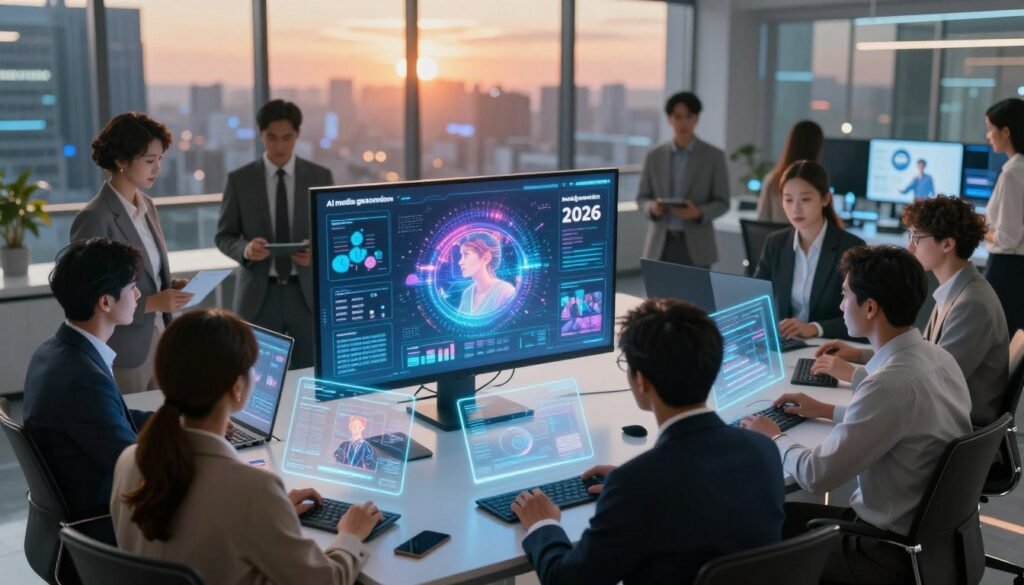
Media production tools now compete on two critical fronts: compositional accuracy for images and physics simulation for video. The race has moved beyond simple aesthetics.
Image Generation: Composition and Style Benchmarks
The focus has shifted to compositional reasoning. Systems must correctly interpret complex prompts involving multiple objects and spatial relationships.
Benchmarks like T2I-CoReBench measure this. They score instance count, attributes, spatial relations, and deductive reasoning.
| Model | Overall Score | Key Strength |
|---|---|---|
| Qwen-Image | 78.0 | Reasoning (85.5) |
| FLUX.1-Krea-dev | 56.0 | Open-source workhorse |
| HiDream-I1 | 50.3 | Balanced performance |
| PixArt-Σ | 30.9 | Specialized style |
Qwen-Image leads with strong reasoning. Architectural innovations like the Multimodal Diffusion Transformer (MMDiT) improve accuracy. They use separate weights for image and language understanding.
Video and Audio: Physics Simulation and Synchronization
For video, 2026 marks the end of the silent film era. Synchronized dialogue and sound effects are now standard.
OpenAI’s Sora 2 added synchronized audio. Google’s Veo 3 applies a latent diffusion process jointly to audio and video latents. This creates native, coherent sound.
Runway Gen-3 focuses on creator workflow. It offers editing controls like the “Multi-Motion Brush” for speed and usability.
Despite advances, depicting human actions remains a challenge. VBench-2.0 shows accuracy is still around 50%. This splits the market between physics-accurate world models and practical creator tools.
AI in Scientific Discovery and Advanced Research Applications
The frontier of system capability has shifted from understanding existing data to generating verifiable, novel scientific insights. This represents the most profound application of modern tools.
Google DeepMind’s AlphaFold 3 is a paradigm shift. It no longer just predicts protein structure. This model predicts the structure and interaction of all life’s molecules, including proteins, DNA, RNA, and ligands.
It provides at least a 50% improvement for these critical interactions. Experts state this is “transforming drug discovery.”
In materials science, the GNoME project discovered 380,000 new, stable materials. These are candidates for better solar cells, batteries, and potential superconductors.
AlphaFold 3’s architecture is innovative. It combines an improved module with a diffusion network. This technique is akin to those in image generators.
It assembles its final molecular structure from a “cloud of atoms.” This uses core technology similar to platforms like Midjourney.
A fundamental distinction emerges. Large language models are “knowledge engines.” They retrieve and reason about existing human data.
Systems like AlphaFold 3 and GNoME are discovery engines. They create new additions to human knowledge itself.
While public attention focuses on chatbots, the most transformative race involves solving fundamental R&D bottlenecks. It reshapes the physical world.
Technical Deep Dive into Cutting-Edge Architectures and Algorithms
Architectural decisions, not just parameter counts, define the efficiency and specialization of modern tools. Understanding these designs explains why one platform excels in a specific task.
Retrieval-Augmented Generation and Transformer vs. MoE
Retrieval-Augmented Generation (RAG) is a cost-effective method for enhancing a model with proprietary data. It works through a four-step process: query, retrieve, augment, and generate.
This gives the system new “just-in-time” context without expensive retraining. For raw computational efficiency, Mixture-of-Experts (MoE) architecture is key.
A Dense Transformer activates all parameters for every input token. An MoE model uses a gating network to route each token to only a few specialized experts.
This is why a model like Kimi K2, with 1 trillion total parameters, can operate so fast. Only a small fraction of parameters are active per token.
Hybrid Architectures and Constitutional AI (CAI)
Hybrid designs push efficiency further. The Hybrid Transformer-Mamba (Hymba) architecture replaces most self-attention layers with efficient Mamba layers.
This can yield up to 3x faster inference speed while maintaining accuracy. For safety, Anthropic uses Constitutional AI (CAI) with its Claude Opus model.
CAI is a two-stage self-correction process. The model critiques and rewrites its own responses against a set of principles.
This self-corrected data fine-tunes the model, resulting in a substantially improved safety profile.
These architectural choices directly guide professional selection.
| Architecture Type | Core Feature | Key Benefit | Example Model |
|---|---|---|---|
| Mixture-of-Experts (MoE) | Sparse expert routing | High efficiency at scale | Gemini 2.5 Pro |
| Hybrid Transformer-Mamba | Mamba layers for context | Ultra-fast inference speed | NVIDIA Nemotron |
| Constitutional AI (CAI) | Self-correction framework | Enhanced safety alignment | Claude 4.5 Sonnet |
Practical Use Cases: Selecting the Right Model for Your Needs
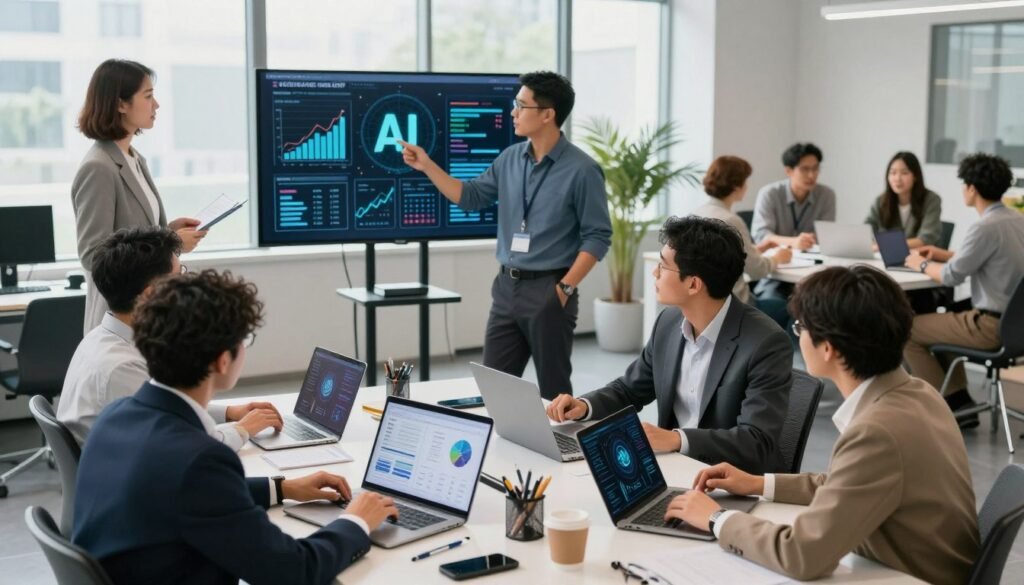
Effective workflows are built by selecting systems optimized for distinct use cases like writing or development. The right tool for a task depends on its specialized capabilities.
Professionals achieve top results by matching a platform’s core strengths to their specific needs. This section provides actionable guidance for common scenarios.
Content Creation, Writing, and Research Applications
For drafting and editing text, Claude Sonnet 4 is the primary choice. Its ability to match a personal writing style is unmatched.
Use GPT-5.1 for brainstorming and outlining new ideas. In research, Perplexity Sonar Pro leads for fact-checking. It provides superior citation capabilities.
GPT-5.1 complements this by synthesizing information into clear insights.
| Use Case | Primary Tool | Secondary Tool | Key Strength |
|---|---|---|---|
| Content Writing | Claude Sonnet 4 | GPT-5.1 | Style matching |
| Coding & Development | Claude Opus 4.5 | Gemini 3 Pro | Refactoring |
| Research & Fact-Checking | Perplexity Sonar Pro | GPT-5.1 | Citations |
| Creative & Social Media | Grok 4 | Gemini 3 Pro | Trends & video |
| Business Strategy | Claude Sonnet 4 | GPT-5.1 | Reasoning & research |
Coding, Business Strategy, and System Integration
For complex coding, Claude Opus 4.5 is exceptional. It scores higher on internal performance exams than any human candidate.
This makes it unbeatable for multi-file refactoring and debugging tasks. In business strategy, combine Claude’s extended thinking mode with GPT-5.1’s deep research.
This pairing creates a powerful toolkit for strategic planning and analysis. Using multiple models strategically reduces bias.
Comparing outputs side-by-side improves quality through creative synergy. The best approach often involves several specialized tools.
Economic Impact and Subscription Models in the Startup Ecosystem
For startups and creators, the financial reality of accessing top-tier intelligence tools has become a significant hurdle. The need for multiple specialized systems creates a unique cost barrier.
Professionals genuinely require different platforms because no single one excels at every task. This leads to the “$110 problem“.
Cost-Benefit Analysis of Multiple Premium Subscriptions
Subscribing individually to ChatGPT Plus, Claude Pro, Gemini Advanced, Perplexity Pro, and Grok Premium costs $110 every month. That totals $1,320 per year.
For early-stage teams and individual creators, this cumulative fee creates real financial pressure. The pursuit of high quality across writing, coding, and research becomes expensive.
All-in-One Platforms vs. Individual AI Model Fees
Unified platforms like AiZolo present a powerful alternative. For $9.9 a month, users get access to all premium models: GPT-5, Claude Sonnet 4, Gemini 3 Pro, Grok 4, and Perplexity Sonar Pro.
This saves over $100 monthly, or $1,201 annually. The AiZolo Pro plan includes 3 million tokens per month. This allows analysis of 4,500 text pages.
It also offers unlimited comparisons and custom API support. Such platforms are democratizing access to top-tier capabilities. They solve the budget problems for many professionals.
Emerging Trends and the Global AI Rivalry in 2026
A fundamental shift in power dynamics is reshaping the development of intelligent platforms worldwide. The performance gap between U.S. labs and competitors from China, France, and other regions has nearly vanished.
Labs in these areas are now major competitors and even leaders in key specialties.
Shifting Power Dynamics Between US, China, and Europe
China’s position as a top-tier competitor is confirmed by systems like Moonshot’s Kimi K2. This trillion-parameter model leads in specific benchmarks like Tau2-bench Telecom.
European and other international labs are also emerging as significant players. They are diversifying the ecosystem beyond a traditional U.S.-centric narrative.
Adaptation of Open-Source Models in a Competitive Market
Open-source tools are disrupting traditional advantages. Meta’s Llama 4 Scout features an industry-leading 10 million token context window.
This democratizes massive-scale data processing. Analyzing entire codebases is no longer limited to expensive closed-source APIs.
Models like Qwen3-Max get very close to top commercial performance. They offer appealing, cost-effective choices for self-hosting solutions.
Newer international models like Kimi K2 Thinking do face latency challenges. These are likely optimization issues, not fundamental architectural problems.
Tracking these evolving tools is essential for maintaining a competitive edge. The landscape now features rapid innovation from diverse global sources.
Conclusion
The core lesson from this extensive comparison is that functional specialization trumps general supremacy. The performance of top systems is extremely close. Selecting the right tool depends on matching its architectural strengths to your precise needs.
For modern developers, the key skill is system architecture. This involves identifying problems, choosing specialized platforms for specific functions, and integrating them into robust, cost-effective workflows. Practical considerations like processing speed and context limits matter.
Winning requires strategic thinking about portfolios, not loyalty to one brand. Use platforms that offer access to multiple tools for analysis. Continuously learn and adapt as new benchmarks and global innovations emerge.